Heart Attack vs Cardiac Arrest
Most people use the terms “heart attack” and “cardiac arrest” interchangeably, which is understandable, both are serious cardiac emergencies, and both can be fatal. But they are different events with different causes, different symptoms, and different first responses. Confusing them is not just a matter of imprecise language. It can lead a bystander to wait for an ambulance when the situation calls for CPR, or to start CPR on a conscious person who is having a heart attack and does not need it.
The clearest framework for understanding the distinction is simple: a heart attack is a plumbing problem, and cardiac arrest is an electrical problem. Both happen in the heart, but at different levels of the system, and each one demands a different first response from the person standing nearby.
What a Heart Attack Is
A heart attack, the medical term is myocardial infarction, occurs when blood flow to a portion of the heart muscle is blocked. The blockage is almost always caused by a plaque buildup rupturing inside a coronary artery, triggering a clot that narrows or completely occludes the vessel. When that happens, the part of the heart muscle supplied by that artery begins to die from oxygen deprivation. The longer the blockage persists, the more tissue dies.
During a heart attack, the heart typically continues beating. The person is usually conscious, often in significant pain or discomfort, and usually able to speak and respond. The condition is serious, it requires emergency treatment, but it is not immediately the same as cardiac arrest. Survival depends on how quickly blood flow can be restored: through clot-dissolving drugs or, more commonly, through cardiac catheterization and stenting performed in a hospital.
Upcoming CPR Class Dates and Times
A heart attack can, however, lead to cardiac arrest if the electrical system of the heart is disrupted by the damage. This is one reason heart attacks in progress are treated as true emergencies: the window during which the rhythm is vulnerable is also the window during which the event can escalate.
What Cardiac Arrest Is
Cardiac arrest is a failure of the heart’s electrical system. The heart stops pumping effectively, either because it has gone into an uncoordinated quivering rhythm called ventricular fibrillation, because it has stopped completely, or because it is producing electrical signals that are not generating effective pumping (pulseless electrical activity). The result is the same in every case: blood ceases to circulate, and the person loses consciousness within seconds.
Cardiac arrest is immediately life-threatening in a way that a heart attack is not. Without intervention, brain damage begins within four to six minutes. Death typically follows within ten. The heart will not restart on its own from ventricular fibrillation, it requires defibrillation to restore a normal rhythm. In the absence of defibrillation, high-quality CPR is the only way to maintain any circulation to the brain and organs during the interval before a defibrillator is available.
Cardiac arrest can happen in people with no prior cardiac history. Structural heart abnormalities, electrolyte disturbances, drug toxicity, and trauma can all trigger sudden cardiac arrest in individuals with no diagnosed heart disease. This is why sudden cardiac arrest in young athletes, who appear completely healthy, is not as rare as people assume.
Key Differences Between the Two
The table below captures the essential contrast, but the most practical distinction is consciousness and pulse. A person having a heart attack is typically awake, in pain, and breathing. A person in cardiac arrest is unresponsive and not breathing normally, or is producing only agonal gasps, which are not effective breaths. This single observation is what should guide a bystander’s response.
Heart attack: the heart is still beating, the person is conscious, the problem is a blocked artery reducing blood flow to heart muscle, and the treatment is hospital-based (clot removal, stenting). First aid role: call 911, keep the person calm and still, give aspirin if available and the person is not allergic, do not leave them alone.
Cardiac arrest: the heart has stopped pumping effectively, the person is unresponsive and not breathing normally, the problem is an electrical failure in the heart’s rhythm, and the treatment is CPR plus defibrillation. First aid role: call 911 immediately, begin CPR, retrieve and use an AED as soon as possible.
Warning Signs and First Response
Heart attack warning signs typically build over minutes and can include: chest pain, pressure, tightness, or squeezing that may radiate to the arm, jaw, neck, or back; shortness of breath; nausea or lightheadedness; cold sweat; or an unusual feeling of impending doom. Symptoms can be subtler in women, fatigue, jaw pain, and nausea without dramatic chest pain are more common in female heart attack presentations, which is why women’s cardiac events are sometimes dismissed or misdiagnosed.
Call 911 immediately for suspected heart attack symptoms. Do not drive the person to the hospital unless EMS response time would prevent timely care; EMS can begin treatment en route and communicate with the receiving facility. Have the person sit or lie in whatever position is most comfortable. If they are not allergic to aspirin and have no contraindication, a regular aspirin (325mg) or four baby aspirin chewed (not swallowed whole) can reduce clot growth while waiting for EMS.
Cardiac arrest warning signs are sometimes preceded by the same symptoms as a heart attack, but often there is no warning at all. The person simply collapses. If a person is unresponsive, check for normal breathing by looking at the chest. Agonal gasping, infrequent, gasping breaths, is not normal breathing. If there is no response and no normal breathing, treat it as cardiac arrest: call 911 and begin CPR immediately.
How CPR and AEDs Fit In
CPR is for cardiac arrest, not for heart attack. Performing chest compressions on a conscious person who is breathing and has a pulse is not appropriate and is not the standard response to a heart attack. The role of a bystander in a heart attack is to call 911, keep the person calm, and administer aspirin if appropriate. The role in a cardiac arrest is fundamentally different: provide CPR and use an AED.
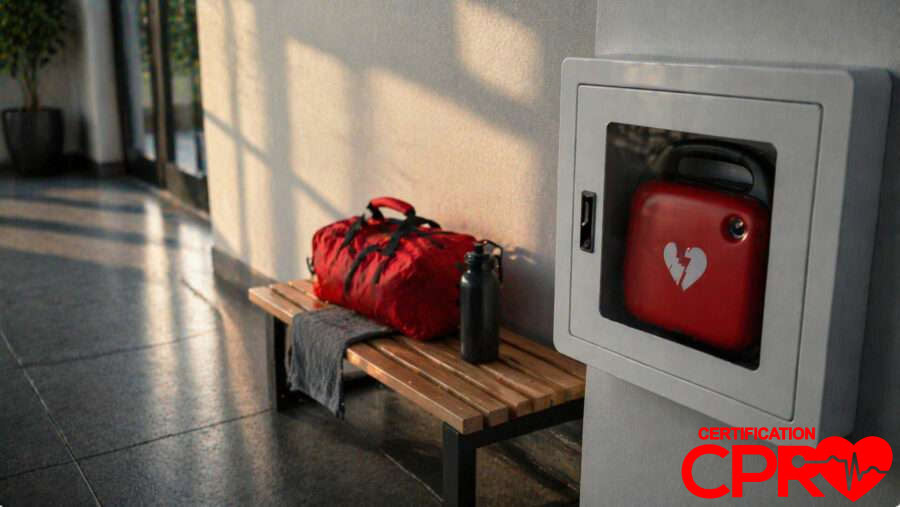
An AED, automated external defibrillator, delivers an electric shock that can terminate ventricular fibrillation and allow the heart’s own natural pacemaker to resume normal rhythm. It cannot do anything for a blocked coronary artery. The device is designed specifically to address the electrical failure that causes cardiac arrest, and it is not relevant to the management of a heart attack.
Understanding this distinction makes CPR and AED training more useful, not less. A trained bystander who can recognize that a collapsed person is in cardiac arrest, not just having a heart attack, and responds accordingly, starting CPR and retrieving an AED, is operating exactly as the training intends. That clear-headed recognition of what is happening, and what the correct response is, is exactly what the moment requires.